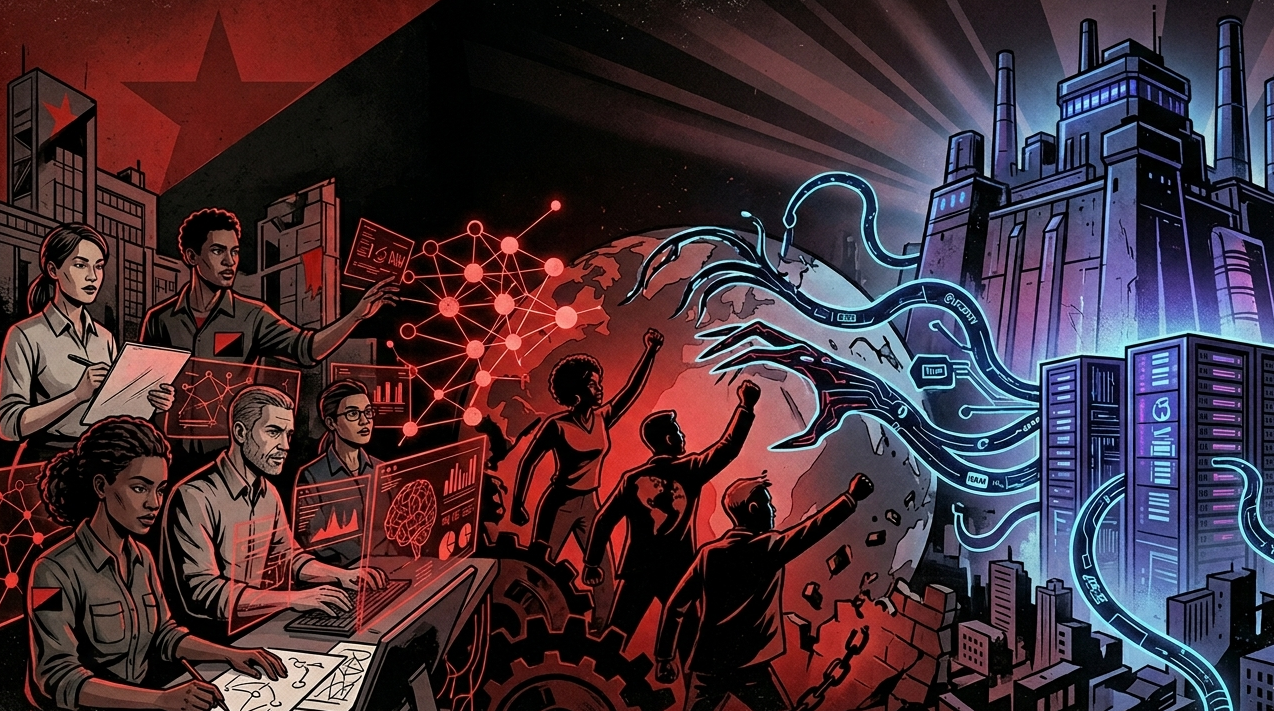
A Materialist Pamphlet on the 2026 AI Capex Cycle
§1. Naming the Crime
Marx, Capital Vol. I, Ch. 26: “the so-called primitive accumulation, therefore, is nothing else than the historical process of divorcing the producer from the means of production.”
Heidegger, in The Question Concerning Technology, named the second movement: Bestand, or standing-reserve. Once everything that exists is reframed as a resource for technical operation, the human being itself becomes raw material. This is not metaphor. It is the operative concept of every Big Tech earnings call. The user is data. The artist is training material. The worker is a “cost center.” When Mark Zuckerberg told Meta employees on April 30, 2026 that the company had “two major cost centers” (compute and people), he was not being callous. He was being precise. He was reading aloud from the manual.
Fredric Jameson, in Postmodernism, or, the Cultural Logic of Late Capitalism, identified the phase we are still in: capital’s penetration into “hitherto uncommodified areas”, the unconscious, nature, culture, aesthetics. Jameson wrote that in 1991, before smartphones, before platforms and social media, before LLMs. The cognitive commons was the last unenclosed terrain. The 2026 capex cycle is its enclosure. There is no remaining outside. The substrate of thought itself is being brought inside the price system.
The 2026 AI capex cycle is the largest single act of accumulation by dispossession in the post-1945 economy. Its mechanism is the conversion of the producer into standing-reserve. Its scale is $725 billion in twelve months from four firms. Its method is to enclose first and litigate later. Its alibi is the future. Its product is rent.
The names of the principals are not secret. Sundar Pichai. Andy Jassy. Satya Nadella. Mark Zuckerberg. Their boards. Their investors. Vanguard, BlackRock, State Street holding the index positions. The asset managers who do not need to know what AI is to know that they are long the trade. Behind them, the ideologues whose job is to launder the operation as inevitability: Marc Andreessen, Peter Thiel, Sam Altman, Elon Musk, the smaller subscribers writing the manifestos in advance to make compliance look like consent.
This is not analysis. It is an indictment. The analysis follows.
§2. The Commons That Was Stolen
Common Crawl is a 9.5-petabyte archive of the open web, scraped without consent. It supplied over 80% of GPT-3’s training tokens. Wikipedia, GitHub, Stack Overflow, every personal blog, every fan forum, every open digital library, every Reddit thread before Reddit walled itself off and sold the access for $60 million a year to Google and roughly $70 million to OpenAI: this corpus was produced by hundreds of millions of unpaid contributors over twenty-five years, as use-value, as gift, as the labor of building a public commons of human knowledge. It was retroactively converted into the fixed capital of four companies.
There is an old word for this. It is not “scraping.” It is theft.
The legal acknowledgment is partial and humiliating. In September 2025, Anthropic settled Bartz v. Anthropic for $1.5 billion after Judge William Alsup found the company had downloaded seven million pirated books from LibGen, Books3, and the Pirate Library Mirror. It is to date the largest copyright settlement in U.S. history. The training itself was ruled fair use. Only piracy of acquisition was infringing. The legal regime, as currently applied, holds that you may convert the entire literary inheritance of the human species into the substrate of a commercial product, but you must download it from a paid source if one exists. This is not a settlement. It is a license to expropriate, with handling fees attached.
Walter Benjamin, in 1936, wrote that mechanical reproduction would strip the work of art of its aura. He underestimated the operation. The aura is not stripped. It is digested. The text was once a thing made by a person, located in a tradition, addressed to other people. It has been ground into the substrate of a probability distribution and resold as cognition. The producer is not credited. The producer is not paid. The producer is not even told.
Jameson, again: late capitalism produces a cultural logic in which pastiche replaces parody: the random cannibalization of all the styles of the past, with no critical position from which to cannibalize them. The LLM is the pastiche-machine made literal. It does not parody. It cannot. It has no position, only a weighted average of all positions. Every output is the recombinatorial residue of every input, with the relations of production that produced the inputs efficiently scrubbed. This is the formal triumph of late capitalism: a technology that consumes culture in the absence of critique, and that sells the consumption back as service.
This is what enclosure looks like in the cognitive register. The fence goes up. The lawyers argue over who owns the fence. The commoner is not party to the negotiation.
§3. The Moment It Becomes Infrastructure
Alphabet, Amazon, Microsoft, and Meta committed approximately $725 billion in 2026 capital expenditure. A 77% increase over 2025. CreditSights’ top-five hyperscaler estimate including Oracle reaches $750 billion. The capital flows almost entirely into data centers, GPUs, custom silicon, and twenty-year power purchase agreements that route around the public grid.
The same four firms cut 85,411 jobs in the first four months of 2026.
The contradiction is the point. Zuckerberg, in the April 30 town hall: “We basically have two major cost centers in the company: compute infrastructure and people-oriented things… that means we do need to take down the size of the company somewhat.” Hannah Arendt’s banality of evil finds its 21st-century instantiation here. Not the snarling villain. The CFO with a slide deck. The line item. Meta’s $145 billion 2026 capex is roughly five times its entire annual compensation bill. Firing every Meta employee would not fund one year of infrastructure. The workforce was never the binding constraint. The workers were a rounding error to be reduced.
This is not AI productivity displacement. It is capital reallocation, in the textbook pattern Marx described in Capital Volume I, Chapter 25: the rising organic composition of capital, the substitution of dead labor for living labor, the immiseration of the worker as precondition for the deepening of fixed capital. The “AI restructuring” framing is the alibi. The mechanism is older than the technology by 150 years.
The class composition reveals what aggregate numbers obscure. Goldman Sachs economist Elsie Peng’s April 6, 2026 U.S. Daily note found AI substitution destroying 25,000 U.S. jobs per month against augmentation adding back 9,000, a net loss of 16,000. Workers aged 22–25 in AI-exposed roles are down 16% in under three years. Programming, customer service, paralegal, accounting: gutted at the entry level. Meanwhile AI-skilled roles command a 56% wage premium and roughly 275,000 openings sit unfilled. The labor market is not collapsing. It is segmenting. The workers being laid off are not the workers being hired. A generation of white-collar entrants is being locked out of the credentialing ladder that built the postwar professional class. The same ladder their parents were promised was the reward for educational achievement, the same ladder the entire ideological apparatus of meritocracy was constructed to legitimate. The ladder is being kicked away in real time, on earnings calls, in the tone of someone reading a quarterly target.
Jameson’s diagnosis bites here. Late capitalism, he argued, produces a waning of historicity: an inability to think outside the perpetual present, to imagine that things have been different or could be different. The Gen Z worker watching her cohort displaced by an LLM does not have access to the historical memory of, say, the 1930s, when comparable displacements produced the Wagner Act, the CIO, social democracy. He has access to LinkedIn and TikTok, where the displacement is reframed as personal failure to “upskill,” as inadequate prompt engineering, as a deficiency of grit. The political instinct that would once have been organized into a labor movement is now atomized into self-help and despair. This is not accidental. The dissolution of historical consciousness is the precondition of the dispossession.
The externalities are socialized. The PJM grid’s 2025/26 capacity auction cleared at $269.92/MW-day, an 833% jump from $28.92. PJM’s own market monitor attributed 63% of the increase, $9.3 billion, to data center demand. Ratepayers in thirteen states are paying for the boom. Phoenix-area data center water consumption is projected to rise from 385 million gallons annually to 3.7 billion. Meta’s Hyperion campus in Louisiana covers 3,650 acres, twice the size of New Orleans’ main airport. Two-thirds of new hyperscale facilities built since 2022 sit in high-water-stress counties. The grid, the watershed, the soil, every commons within reach of the data center, is being levied to subsidize the private accumulation.
Once concrete is poured and PPAs are signed, the configuration is not reversible on policy timescales. The enclosure becomes infrastructure. Infrastructure becomes politics. Politics becomes inheritance. We are choosing the next forty years, now, by default, in the absence of any organized counter-power.
§4. Sovereign AI as Comprador Ideology
The dominant counter-narrative to American capital concentration is “sovereign AI.” Macron pledges €109 billion. Modi funds an IndiaAI Mission. MBS deploys HUMAIN. The UAE deploys Falcon. Xi subsidizes DeepSeek and the National AI Team. The framing is national autonomy. The mechanism is comprador subordination dressed up as flag-waving.
The UAE’s Falcon was trained on AWS. Singapore’s SEA-LION runs on GitHub. Italy’s Modello Italia depends on EU and U.S. silicon. CNAS’s Sovereign AI Index finds the UAE and Japan accounting for over two-thirds of disclosed sovereign investment, all routed through hyperscaler-equivalent stacks. Avasant, putting it more politely than is warranted: “No country today has achieved 100% sovereignty across all layers.”
Frantz Fanon, in The Wretched of the Earth, described the postcolonial national bourgeoisie as a class whose function is to mediate between metropolitan capital and the local population: to manage the extraction, enforce the discipline, take a cut, wear the suit. The current sovereign-AI discourse is the cognitive-infrastructure version of the same role. Macron is not opposing American capital. He is pricing his nation’s compliance. The Indian state is not building an autonomous compute base; it is subsidizing private contractors to operate Silicon Valley’s stack on Indian soil with Indian political cover.
This is the second great mystification of the moment. The first is that the contradiction in the AI economy is between the United States and China. The second is that the answer to American hyperscaler dominance is national champions. Both framings displace the actual contradiction, which is class. Jameson’s term for this displacement was the geopolitical sublime, the substitution of a vast, unrepresentable global system for the actual map of class relations, such that the citizen-subject can only relate to it through nationalist affect. The displaced worker in Ohio, in Hyderabad, in Shenzhen faces the same structural relation. The hyperscaler, American or Chinese, captures the rent. The worker absorbs the displacement. The flag is the analgesic.
§5. The Rent: Cloud Capital and Its Discontents
What follows enclosure is rent.
Yanis Varoufakis calls it cloud capital. Brett Christophers calls it rentier capitalism. The mechanism is identical to landed rent: exclusive ownership of a scarce, capital-intensive, geographically constrained asset, charging permanent fees for access. Microsoft’s commercial remaining performance obligation is $392 billion. Google Cloud backlog is $462 billion. AWS backlog is $364 billion. These are not revenues. They are forward-locked contractual claims, rent capitalized into the present.
OpenAI is structurally subordinate to Microsoft. Anthropic to AWS. The model labs that talk loudest about the future of intelligence are sharecroppers on infrastructure they do not own. Whoever wins the model race, the hyperscalers collect tolls regardless. The “AI race” framing is misdirection on the scale of stage magic. The race already ended. Four companies own the field. The players are paid to perform a contest whose outcome is irrelevant to the house.
Marcuse’s argument in One-Dimensional Man was that technological rationality, under capitalism, is not neutral and carries the social relations of its construction. The model that ingests every commons and outputs probability distributions is not a tool that could be used differently under different ownership. It is a tool whose form is the social relation. To use it is to instantiate the relation. To deploy it at scale is to constitute the worker as standing-reserve, the user as data, the producer as substrate. There is no version of cloud capital that is not this. The technology and the property regime are the same object, viewed from two angles.
Jameson’s most cited line, recycled by Mark Fisher into capitalist realism: “it is easier to imagine the end of the world than the end of capitalism.” The AI discourse is the perfected expression of this paralysis. The models, we are told, may end the world through unemployment, through misalignment, through superintelligence, through climate catastrophe routed through the data center. But the property regime that produces them is not a permissible object of speculation. We can imagine extinction. We cannot imagine public ownership of compute. This is not a failure of intelligence. It is a structural feature of late capitalism’s ideological apparatus, an apparatus LLMs are now poised to industrialize and automate. The system that cannot imagine its own alternative is being given a tool that produces, by design, the median of permissible thought.
The historical parallel is not the dotcom bubble. It is the 1880s railroad cartel. Infrastructure stayed. Rents lasted forty years before the antitrust apparatus broke them. We are at year one of the equivalent cycle, and the antitrust apparatus has been decommissioned by both U.S. parties since the late 1970s.
§6. What Is To Be Done
Diagnosis without program is liberalism. Liberalism, currently, is the ideological wrapper of cloud capital: Mistral and the EU AI Act, ESG-compliant data centers, “responsible AI” working groups, the whole apparatus of professional moral concern that has not stopped a single PPA from being signed. Five directions, none speculative, each with working precedents, each with live policy instruments, each with class enemies who will fight it.
Public compute as utility. The U.S. NAIRR Pilot, EuroHPC’s nonprofit access program, Canada’s Pan-Canadian AI Compute Environment, the UK AI Research Resource. NAIRR is authorized at $2.6 billion over six years. The hyperscalers will spend more than that this week. Compute is general infrastructure, like roads or broadband. The political target is quintupling NAIRR, pairing it with publicly owned data center capacity sited on federal land, and binding it to non-discriminatory access. The opponent is the cloud lobby. Name them.
Public data trusts and statutory licensing. Chan, Bradley, and Rajkumar’s 2023 paper Reclaiming the Digital Commons sketches the mechanism: a fiduciary entity that licenses anonymized training data on behalf of the public, with revenues funding public-interest research. Pair it with statutory licensing modeled on §115 of the Copyright Act, the compulsory mechanical license that has governed music for over a century. The unilateral expropriation becomes a regulated market. The opponent is the IP-maximalist front, which has spent fifty years inflating copyright in the interest of Disney and now finds itself outflanked by capital it once served.
Structural antitrust. The vertical integration of cloud and model labs is the rent mechanism. Separating it is the lever. The European Commission’s Digital Markets Act provides the statutory model. The FTC’s 2023 6(b) inquiry into generative AI investments built the analytical record before being shelved. The specific demand: cloud providers cannot hold equity stakes in the model labs they host, and model labs cannot bind themselves to single-cloud exclusivity. Structurally analogous to Glass-Steagall, to the 1956 IBM consent decree, to the AT&T breakup. The legal authority exists. What does not exist is the political will to apply it. Build the will.
Sectoral labor organization. The firm-by-firm union model is dead at the moment of enterprise, the bargaining unit has fragmented across contractors, freelance creators, and laid-off white-collar workers reabsorbed as gig labor. Sectoral bargaining, on the IATSE/SAG-AFTRA model, with binding minimums on AI training data use, residuals for displaced work, severance protocols, and credentialing protections, is the only structure that scales. The 2023 SAG-AFTRA strike won the first AI provisions in a major U.S. collective bargaining agreement. That is the template, not the ceiling. Writers, journalists, programmers, illustrators, voice actors, translators, paralegals, accountants, customer service workers, teachers, etc., every field being industrialized in the next five years needs a coordinated structure capable of bargaining over its industrialization. The opponent is the firm-by-firm fragmentation the NLRA framework permits and that capital exploits.
International coordination against the bifurcation trap. Refuse the U.S.-vs-China framing. It is the great geopolitical mystification of the age, and it disorganizes class politics by design. The OECD AI Principles, the GPAI, the Council of Europe AI Convention exist. They are weak because no working-class formation has demanded otherwise. Build the formation. The opponent is the national-security apparatus of both blocs, which has every interest in keeping the workers of the world segregated by border.
Closing
Marx’s proposition was not that capital is bad. It was that capital, left unchecked, builds the conditions of its own crisis: the organic composition rises, the rate of profit falls, externalities accumulate, contradictions sharpen until the producers are forced to politicize them. The 2026 capex cycle is that proposition compressed into a single fiscal year, with the contradictions visible to anyone willing to look.
Jameson, in the closing pages of Postmodernism, allowed himself one moment of strategic optimism. He called for cognitive mapping: the recovery of the political subject’s capacity to locate itself within the global system, against an ideological apparatus designed to scramble that capacity. Thirty-five years later, the apparatus has industrialized. The probability machines are now producing the maps, on demand, and the maps that emerge are the median maps, the maps that obscure the very class structure they are meant to chart. The pamphlet is the counter-form. The pamphlet refuses the median. The pamphlet says: this is the structure, these are the principals, this is the mechanism, this is what is to be done. It is a pre-modern technology, deliberately. It exists to do what the LLM cannot.
The infrastructure being built now will determine the distribution of cognitive labor for the next forty years. The hyperscalers know this. The asset managers know this. The sovereign wealth funds know this. They are pricing it in. The question is whether anyone organized in the interest of the producers, rather than the rentiers, is doing the same. The empirical answer right now is no.
That is the political problem. It is also the political opportunity. There is no force of historical necessity here. There is a class that owns the means of cognitive production, a class that produced the inputs and absorbs the displacement, and a short but opened window which the second class can organize before the concrete sets.
Public compute. Public data trusts. Structural antitrust. Sectoral bargaining. International coordination. The program is not the difficult part. The difficult part is the politics, which is to say, the people. Which is to say, the readers of this pamphlet.
The fence is going up. Pull it down.