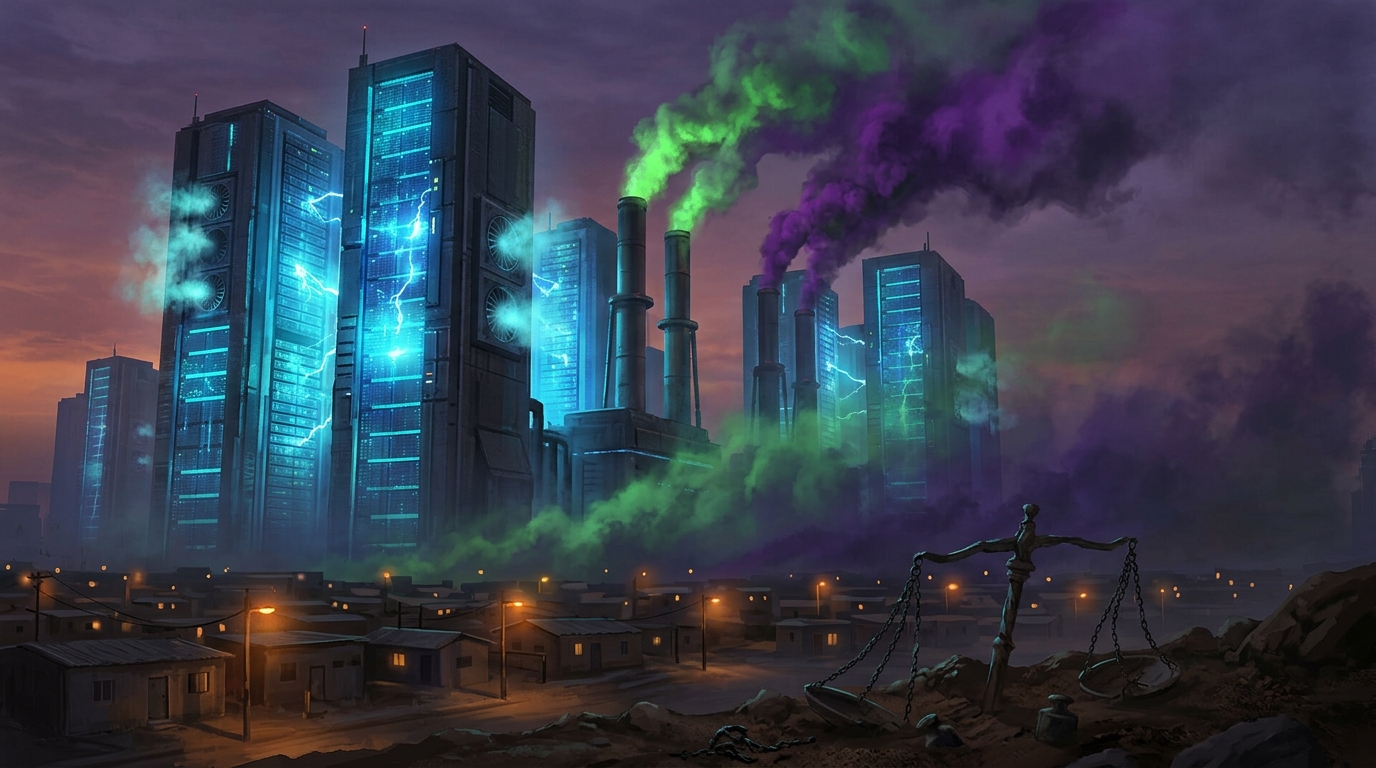
In Southaven, Mississippi, forty-six natural gas turbines sit on flatbed trailers behind an unmarked perimeter fence, burning at full load to train xAI’s Grok-4 on roughly half a million Nvidia GPUs across the state line in Memphis. The state does not regulate them. The trailers technically make them “mobile” sources under federal air law. They have never moved. They are a power plant. The nearest elementary school is one mile away.
The NAACP, represented by Earthjustice and the Southern Environmental Law Center, has filed for emergency injunctive relief in the Northern District of Mississippi. Potential annual emissions are roughly 1,700 tons of nitrogen oxides, 180 tons of fine particulate matter, 500 tons of carbon monoxide, and 19 tons of formaldehyde, a carcinogen. If those figures hold, Colossus 2 is the largest single industrial source of nitrogen oxides in the eleven-county Memphis metropolitan area. The surrounding community is majority Black and already in the upper deciles for industrial pollution exposure in the United States.
This is not an enforcement gap. It is an architecture.
The legal mechanism is a definitional trick. Federal Clean Air Act regulations treat stationary sources of air pollution differently from mobile ones. Stationary sources require permits, emissions limits, public notice, and the application of best-available control technology. Mobile sources are regulated through different and far weaker channels. Mississippi has chosen to read “mobile” literally: a turbine on a trailer chassis is mobile, even if the trailer never moves, even if it is connected by permanent infrastructure to a substation and a data center. The federal agency that would normally challenge this reading is the Environmental Protection Agency. The regional EPA office has been described by attorneys at the Southern Alliance for Clean Energy as “unresponsive or minimally responsive” to formal complaints about Colossus.
The political context is not subtext. Elon Musk contributed approximately $300 million to Donald Trump and Republican causes in the 2024 cycle. He subsequently led the Department of Government Efficiency, an executive-branch entity that reorganized federal staffing and budgets, including at the agencies responsible for environmental enforcement. The current EPA administration, by the assessment of attorneys working the Colossus case, has shown a pattern of granting waivers and declining to enforce. This is the return on investment made legible. The donation is not corruption in the petty sense. It is a hedge against the cost of compliance, purchased at a discount.
The pattern of behavior on the ground matches the hedge. xAI did this once already. At Colossus 1 in Memphis, the company ran unpermitted turbines for over a year under the same mobile-source classification. When the NAACP and SELC issued a formal notice of intent to sue in mid-2025, xAI removed twenty turbines from the site and obtained permits for fifteen. The legal pressure produced the minimum viable concession. Within months, Colossus 2 came online with more turbines than Colossus 1 had ever housed. The strategy is to move faster than litigation. The strategy works because litigation is slow and the political cost of delay falls on the plaintiffs, not on xAI.
There is a temptation to read this as a story about one company and one executive. That reading is too small. Colossus 2 is the visible face of a structural problem in the AI capex cycle: the energy demands of frontier model training exceed what existing grid infrastructure can deliver on the timelines that capital requires. A two-gigawatt training cluster cannot be hooked up to a regional grid through normal interconnection processes. Those processes take years. Foundation model competition is measured in months. The honest responses to this constraint are three: build the grid, build renewable capacity at scale, or slow the buildout to match what infrastructure can support. Each is expensive, technically demanding, and incompatible with the current racing logic of the AI industry. The dishonest response is to build a parallel power system using legal fictions, and to site it where political resistance is lowest.
Black neighborhoods in Mississippi are where political resistance is lowest, by design. The geography of Colossus 2 is not accidental. The Southaven site is in a region with a long history of industrial siting in majority-Black communities, weakly enforced state-level environmental regulation, and limited local political capacity to delay or block infrastructure projects. The Greater Memphis Chamber of Commerce, defending the project, has stated that “confidentiality is a hallmark of economic development.” That sentence is the rhetorical hinge. It naturalizes the absence of public consultation as a feature of the process rather than a failure of it. It treats the affected community as an obstacle to be routed around rather than a constituency with rights.
The materialist reading is direct. The means of producing artificial intelligence (GPUs, electricity, capital) are concentrated in firms valued in the tens of billions. The means of subsistence (clean air, the health of children at the elementary school one mile away) belong to people with no equity stake and no leverage over the decision. This is not exchange. It is appropriation. The pollution is not a side effect of producing intelligence. It is the medium through which intelligence is being produced. David Harvey called this accumulation by dispossession. The dispossession here is of breathable air.
The hegemonic mechanism is transformismo. The Clean Air Act remains on the books. The enforcement apparatus remains nominally intact. The rules apply selectively. The law has stopped applying to people who paid $300 million for it not to.
The founding statement of xAI was that it would develop artificial intelligence for the benefit of humanity as a whole. The humans nearest Colossus 2 are breathing nitrogen oxides and formaldehyde from a power plant that, by federal law as written, is not supposed to exist. The gap between the stated mission and the operational reality is not hypocrisy in any individual sense. It is the structural condition of an industry that has chosen to externalize the costs of its energy crisis onto the communities with the least power to refuse, and to do so with the protective silence of an agency it helped fund into power.
The Memphis externality is not a regulatory failure. It is a system performing exactly as it has been arranged to perform. The rules have not been broken. The rules have been quietly suspended for one class of actor, and the cost of that suspension has been assigned to a community that did not vote for it and cannot afford to leave.